

Lithium-Ion Battery Recycling Industry Trends, Share, and Forecast Through 2030
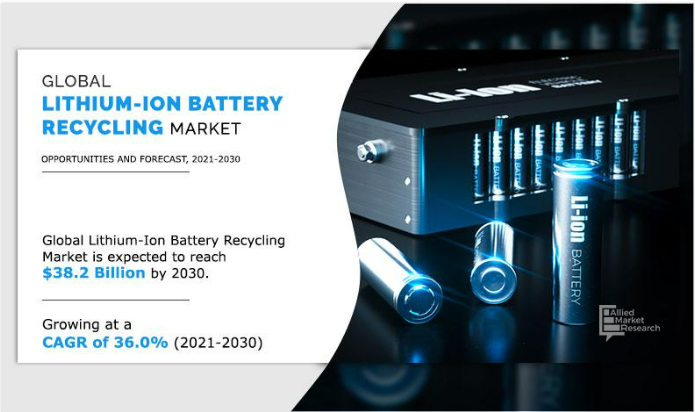
Lithium-ion battery recycling market is projected to reach $38.21 billion by 2030 driven by EV growth.
Rising electric vehicle adoption and battery waste concerns fuel lithium-ion battery recycling market growth.”
WILMINGTON, DE, UNITED STATES, May 29, 2026 /EINPresswire.com/ -- — Allied Market Research
According to a new report published by Allied Market Research, the lithium-ion battery recycling market size was valued at $1.33 billion in 2020 and is projected to reach $38.21 billion by 2030, growing at a CAGR of 36.0% from 2021 to 2030. The rapid expansion of electric vehicles, increasing use of portable electronics, and rising environmental concerns regarding battery disposal are major factors driving the growth of the lithium-ion battery recycling market globally.
Download PDF Brochure: https://www.alliedmarketresearch.com/request-sample/A11683
Introduction
Lithium-ion batteries have become an essential part of modern technology due to their high energy density, lightweight structure, rechargeability, and longer operational life. These batteries are widely used in smartphones, laptops, electric vehicles, industrial equipment, renewable energy storage systems, and numerous consumer electronic devices. As global demand for energy-efficient and portable power solutions continues to increase, the adoption of lithium-ion batteries is growing rapidly across industries.
However, the disposal of used lithium-ion batteries has become a major environmental challenge worldwide. Most end-of-life batteries contain hazardous materials and valuable metals such as lithium, cobalt, nickel, manganese, and aluminum. If these batteries are disposed of in landfills without proper treatment, they can contribute to soil contamination, water pollution, and environmental degradation.
As a result, lithium-ion battery recycling has emerged as a critical solution for reducing environmental impact, recovering valuable raw materials, and supporting sustainable energy initiatives. The lithium-ion battery recycling market is gaining strong momentum as governments, industries, and environmental agencies prioritize circular economy practices and responsible waste management.
Rising Electric Vehicle Adoption Fueling Market Growth
One of the primary drivers of the lithium-ion battery recycling market is the rapid growth of the electric vehicle industry. Governments across the world are encouraging electric mobility through subsidies, tax benefits, and strict emission regulations to reduce carbon emissions and dependence on fossil fuels.
Electric vehicles rely heavily on lithium-ion batteries due to their superior energy storage capabilities and efficiency. As EV adoption increases globally, the number of used and discarded lithium-ion batteries is also expected to rise significantly over the coming years. This creates a growing need for efficient recycling systems capable of recovering valuable battery materials.
Battery recycling helps manufacturers reduce dependency on mining activities while ensuring a stable supply of raw materials such as lithium, cobalt, and nickel. In addition, recycling reduces production costs and minimizes environmental damage associated with raw material extraction.
The increasing deployment of electric buses, electric commercial vehicles, and hybrid vehicles is expected to further strengthen the growth of the lithium-ion battery recycling market during the forecast period.
Environmental Concerns Accelerating Recycling Demand
Growing environmental awareness and stringent government regulations regarding hazardous waste disposal are significantly contributing to the expansion of the lithium-ion battery recycling market. Lithium-ion batteries contain chemicals and heavy metals that can pose serious environmental risks if improperly discarded.
Landfill disposal of batteries can lead to toxic chemical leakage into soil and groundwater systems, negatively impacting ecosystems and human health. Recycling helps prevent environmental pollution by safely processing and recovering valuable battery materials for reuse.
Many countries are implementing strict recycling regulations and sustainability targets to encourage battery collection and recycling initiatives. Environmental agencies are increasingly promoting extended producer responsibility programs that require manufacturers to manage battery disposal and recycling activities.
In addition, the growing global focus on achieving carbon neutrality and supporting green energy transitions is expected to increase investments in battery recycling infrastructure and technologies.
Battery Recycling Becomes a Profitable Industry
Battery recycling was previously considered mainly a regulatory or legislative activity. However, the increasing value of recovered materials has transformed battery recycling into a profitable and strategically important industry.
Lithium-ion batteries contain high-value metals that can be recovered and reused in the manufacturing of new batteries and electronic products. The rising prices of lithium, cobalt, and nickel have made recycling economically attractive for manufacturers and recycling companies.
Companies are investing heavily in advanced recycling technologies to improve recovery efficiency and maximize profitability. Established patented recycling methods are already available in the market, enabling manufacturers and recycling organizations to recover materials more effectively.
The growing emphasis on resource conservation, supply chain security, and sustainable manufacturing is expected to continue supporting the long-term growth of the lithium-ion battery recycling market.
Lithium-Manganese Oxide Segment Dominates Battery Chemistry
Based on battery chemistry, the lithium-manganese oxide segment accounted for the largest lithium-ion battery recycling market share in 2020, holding approximately 32.2% of the market. This segment is expected to maintain its dominance during the forecast period.
Lithium-manganese oxide batteries are widely used in applications such as electricity meters, gas meters, fire alarms, smoke detectors, security systems, and energy storage devices. These batteries offer several advantages including high thermal stability, long operational life, reliability, and improved safety performance.
The increasing demand for energy storage systems and electronic monitoring devices is contributing significantly to the growth of this segment. In addition, technological improvements in battery chemistry and recycling processes are expected to further support market expansion.
As industries continue adopting efficient battery technologies for consumer electronics and industrial applications, the demand for recycling lithium-manganese oxide batteries is expected to rise steadily.
Electronics Segment Leads the Market by Source
On the basis of source, the electronics segment held the largest share of the lithium-ion battery recycling market in terms of revenue and is expected to maintain its dominance during the forecast period.
The widespread use of lithium-ion batteries in smartphones, laptops, digital cameras, tablets, wearable devices, and portable electronics is a major factor driving segment growth. Consumers worldwide are increasingly dependent on electronic devices for communication, entertainment, education, and professional activities.
The rapid replacement cycle of electronic devices generates a large volume of discarded batteries, creating strong demand for efficient recycling systems. In addition, growing e-waste concerns are encouraging governments and manufacturers to adopt responsible recycling practices.
The expansion of the global consumer electronics industry is expected to further increase battery waste generation and support continued growth in the lithium-ion battery recycling market.
Buy This Report (320 Pages PDF with Insights, Charts, Tables, and Figures): https://www.alliedmarketresearch.com/lithium-ion-battery-recycling-market/purchase-options
Electric Vehicle Segment Expected to Grow Rapidly
Although consumer electronics currently dominate the market, the electric vehicle segment is projected to witness the fastest growth during the forecast period, registering a CAGR of 46.1%.
The increasing production and sales of electric vehicles are generating substantial demand for lithium-ion batteries worldwide. As EV batteries reach the end of their operational life, recycling becomes essential for material recovery and environmental protection.
Automotive manufacturers are increasingly partnering with recycling companies to establish closed-loop battery supply chains. This approach helps recover valuable metals while reducing dependency on mining operations and improving sustainability.
The growing adoption of second-life battery applications for energy storage systems is also contributing to the expansion of the lithium-ion battery recycling market.
Hydrometallurgical Process Gains Strong Popularity
Based on recycling process, the hydrometallurgical segment accounted for the largest market share in 2020 and is expected to grow at a CAGR of 39.7% during the forecast period.
Hydrometallurgical recycling involves the use of aqueous solutions and chemical processes to recover valuable metals from used batteries. This process offers several advantages compared to traditional pyrometallurgical methods.
Hydrometallurgical recycling enables treatment of low-grade materials, improved waste control, lower energy consumption, and higher recovery efficiency for lithium and aluminum. These benefits make it one of the most preferred recycling methods in the lithium-ion battery recycling market.
In addition, technological advancements are helping improve recovery rates, operational efficiency, and environmental performance of hydrometallurgical systems. As sustainability becomes a key industry focus, adoption of this recycling process is expected to increase significantly.
Non-Automotive End-Use Segment Holds Largest Share
On the basis of end use, the non-automotive segment held the largest share of the lithium-ion battery recycling market in 2020 and is expected to continue its dominance during the forecast period.
This growth is mainly attributed to the rising demand for second-life battery applications in consumer electronics and energy storage systems. Used lithium-ion batteries from laptops, smartphones, cameras, and portable devices are increasingly being repurposed for less demanding applications.
Second-life battery systems help extend battery lifespan and reduce overall waste generation. Industries are increasingly exploring energy storage applications for reused batteries in renewable energy systems, backup power solutions, and industrial operations.
The growing focus on sustainable resource utilization and waste reduction is expected to support further growth of the non-automotive segment.
Europe Leads the Global Lithium-Ion Battery Recycling Market
Region-wise, Europe dominated the lithium-ion battery recycling market in 2020, accounting for more than 35.7% of the global market share in terms of revenue.
The region’s strong environmental regulations, advanced recycling infrastructure, and growing electric vehicle adoption are major factors supporting market growth. European countries are actively promoting battery recycling to achieve sustainability goals and reduce dependence on imported raw materials.
Governments across Europe are implementing strict waste management regulations and encouraging investments in battery recycling technologies. In addition, the presence of major automotive manufacturers and recycling companies further strengthens the region’s market position.
Countries such as Germany, France, Norway, and the Netherlands are witnessing rapid growth in electric vehicle adoption, which is expected to generate significant opportunities for the lithium-ion battery recycling market.
Asia-Pacific Expected to Witness Fastest Growth
Asia-Pacific is projected to register the fastest CAGR of 40.8% during the forecast period. Rapid industrialization, increasing electric vehicle production, and growing consumer electronics demand are driving market growth across the region.
China, Japan, South Korea, and India are major contributors to battery manufacturing and electric vehicle production globally. The increasing focus on renewable energy storage systems and sustainable manufacturing practices is also contributing to market expansion.
Governments in the region are introducing policies to strengthen battery recycling infrastructure and support circular economy initiatives. The growing availability of raw materials and low-cost manufacturing capabilities are expected to create strong growth opportunities for the lithium-ion battery recycling market in Asia-Pacific.
COVID-19 Impact on the Lithium-Ion Battery Recycling Market
The COVID-19 pandemic had a mixed impact on the lithium-ion battery recycling market. The outbreak disrupted manufacturing operations, supply chains, and recycling activities across multiple industries.
Lockdowns imposed worldwide reduced industrial activities, consumer spending, and demand for electronics and automotive products. This decline negatively affected battery consumption and recycling volumes during the initial stages of the pandemic.
Supply-demand gaps and restrictions on transportation created delays in recycling operations and equipment availability. European countries such as Germany, France, Italy, and Spain implemented strict safety measures that impacted recycling infrastructure and industrial production.
However, the long-term outlook for the lithium-ion battery recycling market remains highly positive. The pandemic accelerated global interest in sustainable technologies, renewable energy systems, and electric mobility solutions, which are expected to drive future market growth.
Competitive Landscape
The global lithium-ion battery recycling market is highly competitive, with major companies focusing on technological innovation, strategic partnerships, and capacity expansion to strengthen their market positions.
Key players operating in the market include Ganfeng Lithium Co., Ltd., American Battery Technology Company, Accurec Recycling GmbH, Akkuser Oy, Duesenfeld GmbH, Li-Cycle Corp., Fortum Corporation, Retriev Technologies, Inc., Lithion Recycling, Inc., and Umicore.
Other important companies in the market value chain include Neometals Ltd., Primobius, Green Li-ion Pvt. Ltd., SungEel MCC Americas, and Redux GmbH.
These companies are investing heavily in advanced recycling technologies and sustainable processing methods to improve recovery efficiency and meet rising global demand.
Get a Customized Research Report: https://www.alliedmarketresearch.com/request-for-customization/A11683
Future Outlook
The future of the lithium-ion battery recycling market appears highly promising due to the growing adoption of electric vehicles, renewable energy systems, and portable electronics worldwide. As battery usage increases across industries, the need for efficient recycling solutions will become increasingly important.
Governments and private organizations are expected to invest heavily in recycling infrastructure, advanced processing technologies, and sustainable waste management systems. The development of circular economy models and closed-loop battery supply chains will further support market growth.
Technological advancements in hydrometallurgical recycling, automation, and material recovery processes are expected to improve operational efficiency and profitability. In addition, growing environmental awareness and strict regulations regarding hazardous waste disposal will continue driving adoption of battery recycling solutions.
With rising global emphasis on sustainability, resource conservation, and green energy transitions, the lithium-ion battery recycling market is expected to witness remarkable growth and create substantial opportunities through 2030.
Trending Reports in Energy and Power Industry:
Lithium-Ion Battery Recycling Market
https://www.alliedmarketresearch.com/lithium-ion-battery-recycling-market-A11683
Battery Recycling Market
https://www.alliedmarketresearch.com/battery-recycling-market
EV Battery Reuse Market
https://www.alliedmarketresearch.com/ev-battery-reuse-market-A31427
Battery Materials Recycling Market
https://www.alliedmarketresearch.com/battery-materials-recycling-market-A107696
Transportation Battery Recycling Market
https://www.alliedmarketresearch.com/transportation-battery-recycling-market-A17401
Energy Storage System Market
https://www.alliedmarketresearch.com/energy-storage-system-market-A280994
Sodium Sulfur Batteries Market
https://www.alliedmarketresearch.com/sodium-sulfur-batteries-market
Sodium Ion Battery Market
https://www.alliedmarketresearch.com/sodium-ion-battery-market-A10597
Lithium Sulfur Battery Market
https://www.alliedmarketresearch.com/lithium-sulfur-battery-market-A12076
Lithium-ion Battery Market
https://www.alliedmarketresearch.com/lithium-ion-battery-market
Battery Swapping Market
https://www.alliedmarketresearch.com/battery-swapping-market-A109671
Battery Technology Market
https://www.alliedmarketresearch.com/battery-technology-market
Lead–Acid Battery Market
https://www.alliedmarketresearch.com/lead-acid-battery-market-A05962
Redox Flow Battery Market
https://www.alliedmarketresearch.com/redox-flow-battery-market
Vanadium Redox Flow Battery (VRB) Market
https://www.alliedmarketresearch.com/vanadium-redox-flow-battery-vrb-market-A193313
U.S. Forklift Battery Market
https://www.alliedmarketresearch.com/us-forklift-battery-market-A07523
Cylindrical Li-ion Battery Market
https://www.alliedmarketresearch.com/cylindrical-li-ion-battery-market-A155333
About Us
Allied Market Research (AMR) is a full-service market research and business-consulting wing of Allied Analytics LLP based in Portland, Oregon. Allied Market Research provides global enterprises as well as medium and small businesses with unmatched quality of "Market Research Reports" and "Business Intelligence Solutions." AMR has a targeted view to provide business insights and consulting to assist its clients to make strategic business decisions and achieve sustainable growth in their respective market domain.
Pawan Kumar, the CEO of Allied Market Research, is leading the organization toward providing high-quality data and insights. We are in professional corporate relations with various companies and this helps us in digging out market data that helps us generate accurate research data tables and confirms utmost accuracy in our market forecasting. Each and every data presented in the reports published by us is extracted through primary interviews with top officials from leading companies of domain concerned. Our secondary data procurement methodology includes deep online and offline research and discussion with knowledgeable professionals and analysts in the industry.
David Correa
Allied Market Research
+ + + + + + + + + + + + +1 800-792-5285
email us here
Visit us on social media:
LinkedIn
Facebook
YouTube
X
Legal Disclaimer:
EIN Presswire provides this news content "as is" without warranty of any kind. We do not accept any responsibility or liability for the accuracy, content, images, videos, licenses, completeness, legality, or reliability of the information contained in this article. If you have any complaints or copyright issues related to this article, kindly contact the author above.
