

Recycled Ocean Plastic Performance Textile Fiber Market Growth Outlook 2026–2036 Driven by Traceable Sourcing
Recycled Ocean Plastic Performance Textile Fiber Market
Certified marine waste sourcing and audited traceability systems are accelerating adoption of recycled ocean plastic fibers across performance textiles.
NEWARK, DE, UNITED STATES, January 22, 2026 /EINPresswire.com/ -- Market Overview and Growth Outlook
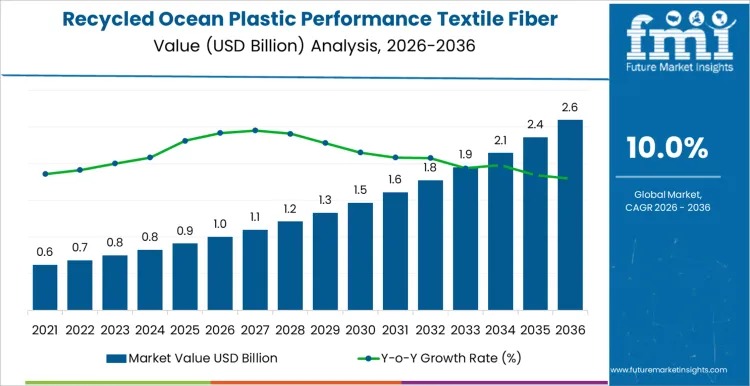
The Recycled Ocean Plastic Performance Textile Fiber Market is entering a scale-up phase where environmental claims are reinforced by measurable performance and governance controls. Valued at USD 1.0 billion in 2026, the market is forecast to reach USD 2.6 billion by 2036, registering a 10.0% CAGR. Growth is anchored in procurement policies that require verified marine waste sourcing, documented chain-of-custody, and stable mechanical properties across repeated production cycles.
Unlike conventional synthetic fibers, sourcing begins at the waste stream. Collection efficiency, sorting accuracy, and preprocessing yields define usable volumes before polymer conversion. As a result, adoption decisions are led by brand material councils and nominated mills rather than opportunistic sourcing. Once a fiber construction is approved, it remains embedded in material libraries for multiple seasons, creating long revenue cycles for qualified suppliers.
Subscribe for Year-Round Insights → Stay ahead with quarterly and annual data updates
https://www.futuremarketinsights.com/reports/sample/rep-gb-31621
Specification Control and Market Participation
Participation in the recycled ocean plastic performance textile fiber market is shaped by strict specification governance rather than price-led sourcing. Brand organizations maintain approved material lists, audit schedules, and disclosure rules that govern supplier access.
Key participation dynamics include:
- Entry dependent on proof of marine waste origin and processing integrity
- Performance validation tied to tensile retention, abrasion resistance, and dye stability
- Supplier rotation occurring mainly during portfolio or platform resets
- Revenue growth linked to the number of certified collections rather than spot demand
This structure favors suppliers that achieve early qualification and sustain compliance across seasons.
Supply Chain Design and Cost Structure
Supply chain architecture defines the commercial rhythm of the market. Volumes depend on long-term collection contracts, preprocessing capacity, and traceability systems capable of withstanding third-party audits.
Operational characteristics shaping value include:
- Inventory segregation by feedstock origin to prevent cross-contamination
- Cost structures influenced by washing intensity, filtration, and quality screening
- Emphasis on run stability and shade consistency to avoid high rework costs
As more apparel and footwear programs standardize marine-sourced recycled content, annual market values are expected to move into the multi-billion range during the early 2030s.
Feedstock Source Dynamics
Feedstock selection is a central risk-management decision in this market, as variability affects processing stability and yield.
Key feedstock insights:
- Post-consumer ocean-bound plastics (~40% share): Favored for predictable bale geometry and sorting outcomes
- Fishing nets and gear: Higher molecular weight, suited for abrasion-intensive applications
- Marine litter and mixed sources: Higher contamination risk and sorting cost
- Blends with land-based recyclate: Used to stabilize variability and improve yield
Economic preference consistently favors streams that reduce stoppages and stabilize mass balance.
Polymer Type and Performance Alignment
Polymer choice follows performance engineering requirements rather than sustainability narratives.
Key polymer trends include:
- Recycled polyester (~44% share): Dominant due to compatibility with heat setting, coating, and lamination
- Recycled polyamide: Selected for toughness and flex fatigue resistance under controlled moisture conditions
- Other recycled polymers: Limited to niche applications with narrow processing windows
Once a polymer family is fixed, qualification matrices, documentation, and customer approvals limit substitution, reinforcing long-term demand stability.
Regional Growth Patterns
Regional adoption reflects how governance frameworks integrate traceability into production systems.
Notable regional trends:
- China (11.2% CAGR): Template-based line rollouts enable rapid scaling across facilities
- USA (9.7% CAGR): Strong demand from performance apparel and footwear brands with audit-driven sourcing
- Germany (9.6% CAGR): Group-wide audit systems govern fiber adoption across manufacturing sites
- South Korea (9.2% CAGR): Architecture-based material standards support synchronized product launches
- Japan (8.5% CAGR): Mature market emphasizing documentation integrity and consistency
Competitive Landscape
Competition centers on traceable sourcing, processing stability, and reproducible performance. Leading players include Aquafil (ECONYL), UNIFI (REPREVE Our Ocean), Indorama Ventures, Bureo, Toray Industries, Hyosung, and Far Eastern New Century.
Competitive positioning is shaped by:
- Ability to deliver uniform lots at industrial scale
- Compatibility with existing spinning, weaving, and finishing systems
- Depth of audit-ready documentation and technical service support
Suppliers integrated early into design roadmaps benefit from extended program lifecycles and predictable volumes.
Strategic Outlook
The recycled ocean plastic performance textile fiber market is evolving into a governed materials category where durability, traceability, and processing reliability carry equal weight. Growth through 2036 will favor suppliers that manage feedstock variability while delivering consistent, audit-compliant performance for mainstream textile applications.
Related Reports
Precipitated Silica Market- https://www.futuremarketinsights.com/reports/precipitated-silica-market
Lithium and Lithium Ion Battery Electrolyte Market- https://www.futuremarketinsights.com/reports/lithium-and-lithium-ion-battery-electrolytes-market
Fiberglass Market- https://www.futuremarketinsights.com/reports/fiberglass-market
Have a specific Requirements and Need Assistant on Report Pricing or Limited Budget please contact us - sales@futuremarketinsights.com
About Future Market Insights (FMI)
Future Market Insights, Inc. (FMI) is an ESOMAR-certified, ISO 9001:2015 market research and consulting organization, trusted by Fortune 500 clients and global enterprises. With operations in the U.S., UK, India, and Dubai, FMI provides data-backed insights and strategic intelligence across 30+ industries and 1200 markets worldwide.
Contact Us:
Future Market Insights Inc.
Christiana Corporate, 200 Continental Drive,
Suite 401, Newark, Delaware - 19713, USA
T: +1-347-918-3531
Why FMI: https://www.futuremarketinsights.com/why-fmi
For Sales Enquiries: sales@futuremarketinsights.com
Website: https://www.futuremarketinsights.com
LinkedIn| Twitter| Blogs | YouTube
Sudip Saha
Future Market Insights Inc.
+1 347-918-3531
email us here
Legal Disclaimer:
EIN Presswire provides this news content "as is" without warranty of any kind. We do not accept any responsibility or liability for the accuracy, content, images, videos, licenses, completeness, legality, or reliability of the information contained in this article. If you have any complaints or copyright issues related to this article, kindly contact the author above.
